Wednesday, March 31, 2021

Preemption in Missouri: Squatter Claims to Land

This article has been modified. See Chapter 12 of "It Was Not Quick and It Was Not Simple: The Saga of Private Land Claims in Missouri". (Go to book now.)


In the late 1790s families from the United States were encouraged by the Spanish to come settle in Upper Louisiana. Generous grants for fertile land and the prospect of mineral riches were hard to resist (Stoddard, pg 249). So the settlers came. By the time the United States acquired the province of Louisiana from the French in 1803, the number of Americans in the province had increased considerably. In a letter to the President, dated October 5, 1803, Thomas T. Davis, a judge in the Indiana Territory, remarked that the Americans were settling fast in Upper Louisiana (Territorial Papers, Vol. 13, pg 7). In a report sent by President Thomas Jefferson to the United States Congress on November 14, 1803, it was estimated that at least two-fifths of all the settlers in Upper Louisiana were Americans (ASP:MISC Vol. 1, pg 348).

Unlike the Spanish, however, the United States government was jealous for its newly acquired land and wanted to restrain new settlement until the land was ready to sell. Section 14 of the Act of March 26, 1804, chapter 38, An Act erecting Louisiana into two territories, and providing for the temporary government thereof (U. S. Statutes at Large, Vol. 2, pg 283), made it unlawful for any person to attempt a new settlement, to designate boundaries or to make a boundary survey of the lands of the United States within the limits of the former Province of Louisiana. Violators could be removed from the public lands by military force, fined up to one thousand dollars and imprisoned for up to twelve months.

President Thomas Jefferson emphasized to the Secretary of War the necessity of preventing squatters from settling on the public lands. The Secretary of War then gave instructions to the District Commandants to prohibit unauthorized settlements. When unauthorized settlements were discovered, any fixed improvements on the land were to be destroyed (Territorial Papers, Vol. 13, pg 19, 53, 54).

New settlers continued to come, however, and where else could they settle but on the public lands? It became difficult for the Commandants to distinguish unauthorized settlers from those having some kind of claim under the Spanish government (Territorial Papers, Vol. 13, pg 82). Some, who had made a settlement after the United States had taken possession of Upper Louisiana in March 1804, filed notice with the recorder of land titles, claiming a settlement right. For example, Francis Clark claimed 250 arpents of land on a branch of the St. Francis River based on a settlement and cultivation made in 1804 (ASP:PL Vol. 2, pg 550). George Horn claimed 300 arpents based upon permission to settle given by Captain Amos Stoddard in 1804 (ASPL:PL Vol. 2, pg 443). Jonathan Vineyard came from Georgia and claimed 500 arpents of land that he had settled in September 1804 (ASP:PL Vol. 2, pg 469).

The Act of March 3, 1807, chapter 46, An Act to prevent settlements being made on lands ceded to the United States, until authorized by law (U. S. Statutes at Large, Vol. 2, pg 445), stated that anyone attempting to make a settlement, designate boundaries or conduct a boundary survey on the public lands after the passage of the act, forfeited any right, title or claim to the land. Anyone who had settled without authorization on the public lands before the passage of this act was to be given three months notice before removal was to be enforced. To avoid removal the settler could apply for permission at any time before January 1, 1808 to continue to occupy up to 320 acres of public land as a tenant at will. Applying for permission, however, required a relinquishment of any claim to the land.

In 1809 President Jefferson reiterated his view that unauthorized settlements should be rigorously prohibited (Territorial Papers, Vol. 14, pg 248). Enforcement, however, remained problematic.

The Act of February 5, 1813, chapter 20, An Act giving the right of pre-emption in the purchase of lands to certain settlers in the Illinois territory (U. S. Statutes at Large, Vol. 2, pg 797), allowed settlers in the Territory of Illinois a preference in the purchase of the land that they had actually and continuously inhabited and cultivated as long as the land was not claimed by anyone else. The purchase preference would be at private sale as opposed to public sale and the tract would be limited to one quarter section per individual purchaser. The person claiming the preference had to deliver a written notice to the register of the land office at least two weeks before the public sales.

Section five of the Act of April 12, 1814, chapter 52, An Act for the final adjustment of land titles in the State of Louisiana and territory of Missouri (U. S. Statutes at Large, Vol. 3, pg 121), extended the purchase preference to the Territory of Missouri under the same restrictions, conditions, provisions and regulations as approved for the Territory of Illinois.

Settlements on the public lands continued, now with the hope of a preference in the purchase of the land (Territorial Papers, Vol. 15, pg 34). The United States government continued to oppose these settlements, however, and President James Madison issued a proclamation on December 12, 1815, ordering that all unlawful occupants should be removed (President Papers, Vol. 2, pg 557). The Secretary of War declared to Governor William Clark that “the premature occupancy of the public lands can be viewed only as an invasion of the sovereign rights of the United States, and must be repressed by the most prompt and energetic measures” (Territorial Papers, Vol. 15, pg 113).

The General Assembly of the Territory of Missouri responded in January 1816, protesting the President’s order and requesting a suspension until the public lands could be surveyed and offered for sale. They felt that such a drastic order deeply affected “the Interest and Welfare of a considerable portion of the Inhabitants of this Territory by taking from them their dwellings which atho’ they do not hold under the sanction of Law they had reason to believe from the indulgence which has been almost uniformly given by Congress not only by their [acquiescence] in such settlements but by extending to them the right of pre’emption they would be permitted quietly to occupy until the public Lands should be surveyed and offered for sale” (Territorial Papers, Vol. 15, pg 108). And, of course, enforcement was still problematic. Alexander McNair, Marshall of the Missouri Territory, in writing to Josiah Meigs, Commissioner of the General Land Office, on January 27, 1816, commented that “five Militia men of this Territory would not march against the intruders on public lands” (Territorial Papers, Vol. 15, pg 110, 111).

The United States government relented somewhat with the Act of March 25, 1816, chapter 35, An Act relating to settlers on the lands of the United States (U. S. Statutes at Large, Vol. 3, pg 260). This act allowed those who had settled on the public lands before February 1, 1816 to apply for permission before September 1, 1816 to continue to occupy up to 320 acres of public land as a tenant at will. The act would remain in force for one year.

The Act of February 17, 1815, An Act for the relief of the inhabitants of the late county of New Madrid, in the Missouri Territory, who suffered by earthquakes (U. S. Statutes at Large, Vol. 3, pg 211), brought a new threat to those hoping for a preference in the purchase of the land that they occupied. This act allowed the New Madrid claimants to locate a tract of land “on any of the public lands of the said territory, the sale of which is authorized by law” to replace their previously confirmed claims. Since those eligible for a preference of purchase could not designate their preemption claim until the public lands were surveyed, a land office was opened and the land made available for sale, it was possible for the New Madrid claimants to locate a claim on public land that was already occupied and improved (Territorial Papers, Vol. 15, pg 238). A New Madrid claim was not certain to prevail, however, since the right of preemption was authorized before the relief to those who suffered from the earthquakes (Territorial Papers, Vol. 15, pg 244; ASP:PL Vol. 4, pg 872).

By 1817 those eligible for a purchase preference were becoming very anxious. The register of the land office at St. Louis was daily receiving requests to enter preemption claims. No preemption claims could yet be accepted, though, because the register did not yet have the township plats on which to identify the preemption claims. The surveys had not yet been completed and land sales had not yet been authorized (Territorial Papers, Vol. 15, pg 282).

The first public land sales in the Territory of Missouri were authorized by the President in 1818 (Territorial Papers, Vol. 15, pg 385). The Act of February 17, 1818, chapter 12, An Act making provision for the establishment of additional land offices in the territory of Missouri (U. S. Statutes at Large, Vol. 3, pg 406), established additional land offices and defined the land district that each office would cover. New land offices were to be established at Franklin in the county of Howard, at a convenient location in the county of Arkansas (for lands located between the Base Line and the north boundary of the State of Louisiana), at the seat of justice in the county of Lawrence (for lands located between the Base Line and the north line of Township 15 North) and at Jackson in the county of Cape Girardeau. The first land office had already been established at St. Louis (Act of March 3, 1811, chapter 46, U. S. Statutes at Large, Vol. 2, pg 662).

In July 1818, Samuel Hammond, the receiver of public moneys at the land office in St. Louis, reported to Josiah Meigs that he and the register, Alexander McNair, had received the preemption claims for the first thirty townships authorized for sale. Most of the claims were clearly within the provisions of the law and there were only a few conflicting claims. There were some issues, however, as some claims turned out to be located in Section 16, which was reserved for the support of schools, and some were located in private claims that had not been confirmed (Territorial Papers, Vol. 15, pg 420).

As the land sales approached and the preemption claims were being considered, questions arose as to what constituted “inhabitation” and “cultivation” so as to qualify for the preference of purchase (Territorial Papers, Vol. 15, pg 423, 429). How much inhabitation and cultivation were required to qualify for the preference? Was a cabin and a garden patch enough? At what point should the inhabitation and cultivation have been established before a preference could be granted? Did it have to commence before April 12, 1814, when the right of preemption was extended to the Territory of Missouri? If a settler was industrious and extended his improvements into what turned out to be more than one quarter section, could he claim a preference for the full extent of his improvements?

To add to the confusion, the Act of April 29, 1816, chapter 162, An Act concerning pre-emption rights given in the purchase of lands to certain settlers in the state of Louisiana, and in the territory of Missouri and Illinois (U. S. Statutes at Large, Vol. 3, pg 330), allowed anyone who qualified for a preference of purchase that had settled on a fractional section or fractional quarter section of less than 160 acres to “have the privilege of purchasing one or more adjoining fractional quarter sections, or the adjoining quarter section, including their improvements, or the fraction improved by them, at their option.” The Act also provided for an adjustment when two qualifying settlers had settled on the same quarter section or fractional quarter section of land, so that each settler would secure his improvements. The Act concluded by stating that “where the improvement of such person shall be upon two or more quarter sections, such person shall be entitled to purchase the quarter sections upon which his improvement shall be.

There was considerable correspondence between the registers and receivers in the land offices, the Commissioner of the General Land Office and the Secretary of the Treasury, trying to work through the confusion, which was compounded by delays in delivery of the mail (Territorial Papers, Vol. 15, pg 432, 440, 460, 463, 470, 473, 484, 486, 499, 502, 509, 511, 522, 524, 525, 528, 536, 542, 550, 599, 602, 608, 647, 659, 662, 702). Added to that confusion were protests and demands sent to Congress by the General Assembly of the Territory of Missouri (Territorial Papers, Vol. 15, pg 489, 495, 502, 594, 656).

The Act of March 3, 1819, chapter 86, An Act explanatory of the act entitled “An act for the final adjustment of land titles in the state of Louisiana and territory of Missouri” (U. S. Statutes at Large, Vol. 3, pg 517), cleared up some points of confusion. There had been some uncertainty as to whether or not the right of preemption applied to the county of Howard, since it was unclear when it had officially ceased to be Indian territory and had become an organized part of the territory of Missouri (Territorial Papers, Vol. 15, pg 440, 460, 463). Section one of this act explicitly extended the right of preemption to the county of Howard as it had been established by the territorial legislature on January 23, 1816. Section three of the act allowed the right of preemption to those that had settled and improved land that ended up being in Section 16 after the surveys were completed. Replacement lands for the support of schools would be selected in the same township.

As in other instances where relief was provided by Congress to those that qualified, there were those who tried to take advantage of the situation to gain a preference, while doing as little as possible to justify it. Ultimately, it was up to the register and receiver of each land office to evaluate the preemption claims presented to them and to extend the relief intended by Congress (Territorial Papers, Vol. 15, pg 599, 602, 608, 662). Charles Carroll, register, and T. A. Smith, receiver for the land office at Franklin in Howard County, explained their proceedings in a letter, dated November 6, 1820, by saying, “We considered the sectional line a Barrier in all cases but one embraced in the first section of the Law of 29th April 1816 & then only permitted them to cross the sectional line to give them the quantity contemplated by Law. A different construction would have allowed an artful & cunning man to have spread over a Township & once pass the barrier & there is no limit. Where two Persons were Settled on one quarter or fractional quarter we gave to each an adjoining qr & half of the quarter they were settled on & where more were settled we divided the section between them. We certainly required Cultivation for the support of a family & did not consider shelots which are indigenous to the country, or the marking of Trees, or planting a few peach Stones or sowing a few appleseeds or putting out a few Scions evidences of cultivation or the Encampment on the ground for a night “actual Inhabitation”, where proof was offered of growing any Crop for the Sustenance of man, even “Turnips”, it mattered not how they were put in whether with the plough, a cane or the hand it was deemed sufficient & the Preemption was granted” (Territorial Papers, Vol. 15, pg 662).
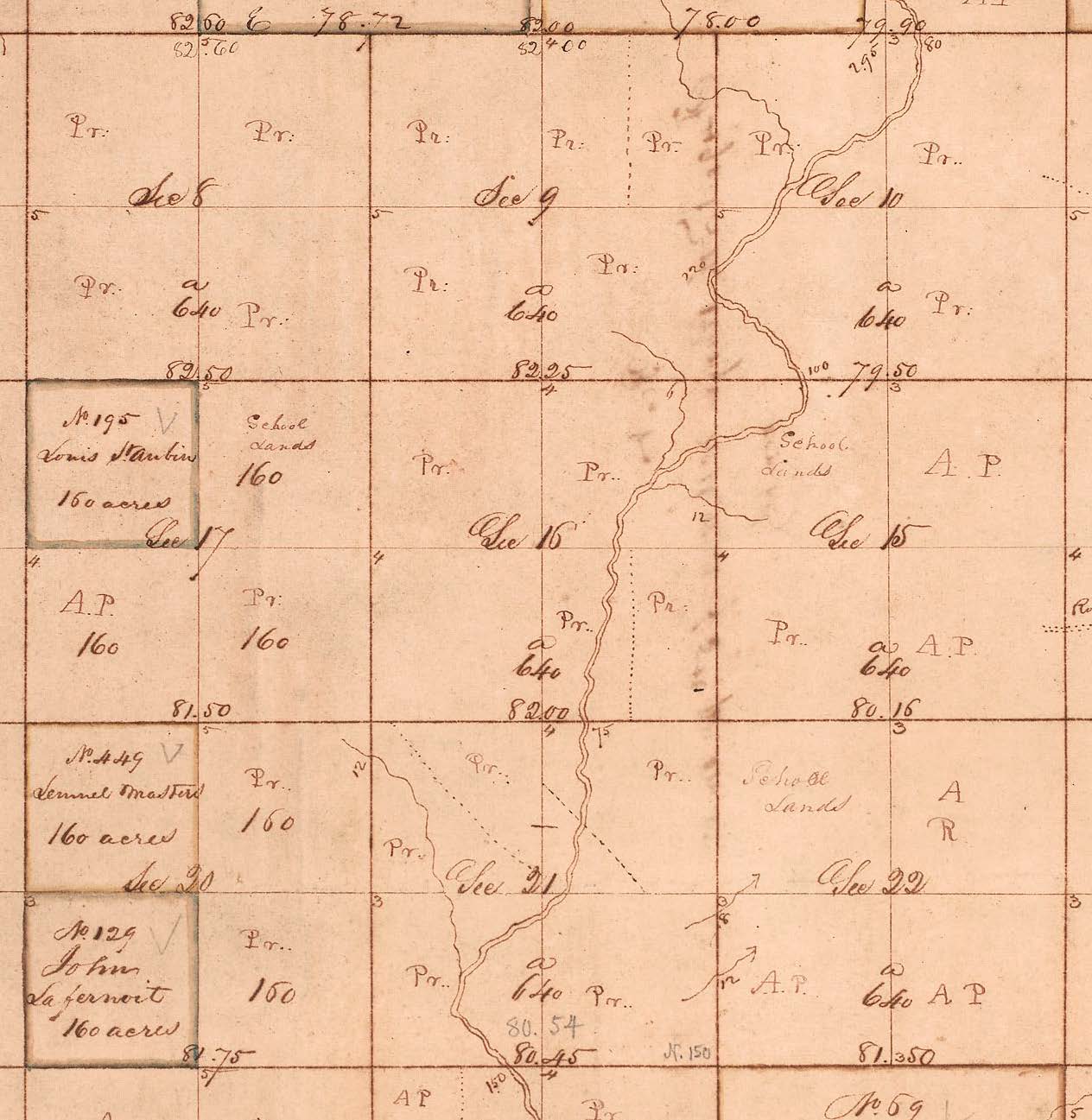


This extract from the marked-up 1816 township plat (the old plat) for Township 49 North, Range 16 West shows tracts of land marked "Pr." to indicate claims by preemption. Notice that the northeast quarter of Section 9, the southeast quarter of Section 16 and the northwest quarter of Section 21 were divided between two settlers.  The northwest quarter of Section 21 was patented as "the northeast corner" (100.5 acres) and the "south part" (59.5 acres).  Also notice that three quarters of Section 16 were claimed by preemption and replacement lands for the support of schools were designated in Sections 15, 17 and 22. New Madrid claims were located in Sections 17 and 20.

According to Section 8 of the Act of May 10, 1800, chapter 55 (2 Stat 73) the register of the land office was to place a letter "A" on the township plat when application was made and 1/20 of the purchase price was paid. A letter "P" was placed on the plat when 1/4 of the purchase price had been paid. A letter "R" was placed on the plat when the land reverted to the United States, because of a failure to pay 1/4 of the purchase price within three months after the date of application. See also Territorial PapersVol. 15, pg 608.


SOURCES

A Compilation of the Messages and Papers of the Presidents

American State Papers: Public Lands (ASP:PL)

American State Papers: Miscellaneous (ASP:MISC)

Stoddard, Major Amos, Sketches, Historical and Descriptive, of Louisiana, 1812

The Territorial Papers of the United States, compiled by Clarence Edwin Carter, 1948

U. S. Statutes at Large


----------------------------------------
original composition by Steven E. Weible

Wednesday, January 27, 2021

Timeless Advice for 2021

The following passage is a father's advice to his young sons; however, it is so timeless and so applicable that young and old, male and female would do well to heed this advice:

Above all else, guard your heart,
for it is the wellspring of life.

Put away perversity from your mouth;
keep corrupt talk far from your lips.

Let your eyes look straight ahead,
fix your gaze directly before you.

Consider the paths for your feet
and take only ways that are firm.

Do not swerve to the right or the left;
keep your foot from evil.

Proverbs 4:23-27 (NIV 1984)

Sunday, January 3, 2021

Claims to Land and the Fifth Principal Meridian

This article has been modified. See Chapter 10 of "It Was Not Quick and It Was Not Simple: The Saga of Private Land Claims in Missouri". (Go to book now.)


The final report of the Board of Revision was expected to reach Secretary of the Treasury Albert Gallatin around the first of March 1812 (Marshall, Vol. 2, pg 216). Soon after the report arrived at its destination, those having certificates for confirmed claims began requesting patents. The land descriptions in the certificates were vague, however, having no reference to adjoining tracts or any common point. By April 1812 Secretary Gallatin had refused to issue any more patents based on these vague descriptions. It was clear that the boundary surveys would have to be completed before the tracts of land could be given a definite location. Thus Secretary Gallatin wanted the principal deputy surveyor to survey all of the confirmed claims, connecting them relative to one another (Territorial Papers, Vol. 14, pg 546).

Section five of the Act of June 13, 1812, chapter 99 (U. S. Statutes at Large, Vol. 2, pg 748), directed the principal deputy surveyor to survey into townships as much land as may be directed by the President of the United States along with all of the confirmed private claims that had not already been surveyed under the authority of the United States. The principal deputy surveyor was further directed to make out a “general and connected plat” of all of the surveys to be made by him along with all those that had already been made.

Meanwhile, the General Land Office was created by the Act of April 25, 1812, chapter 68, An Act for the establishment of a General Land Office in the Department of the Treasury (U.S. Statutes at Large, Vol. 2, pg 716). Edward Tiffin from Ohio was nominated by President James Madison to be Commissioner of the General Land Office and was confirmed by the U.S. Senate on May 6, 1812 (Senate Executive Journal, Vol. 2, pg 262-263). His duties were to manage all activities relating to the public lands of the United States and other lands patented or granted by the United States, as had previously been handled by the offices of the Secretary of State, Secretary and Register of the Treasury and Secretary of War.

Later in 1812 Jared Mansfield resigned as Surveyor General of the United States and returned to the U.S. Military Academy at West Point to take the position of professor of natural and experimental philosophy, which had been newly created by the Act of April 29, 1812, chapter 72 (U.S. Statutes at Large, Vol. 2, pg 720). Josiah Meigs from Georgia was nominated by President James Madison to replace Mansfield and was confirmed by the U.S. Senate on November 16, 1812 (Senate Executive Journal, Vol. 2, pg 303-304). On November 24, 1812, Edward Tiffin sent Meigs his commission and directed him to go to Cincinnati, Ohio, to assume his duties. Tiffin expected that there should be general instructions in the office as had been given to Mansfield by the Secretary of the Treasury to provide Meigs sufficient guidance and direction. Meigs arrived in Cincinnati on March 22, 1813 to find that the first clerk of the office had died (Territorial Papers, Vol. 8, pg 215).

Understandably, Josiah Meigs was uncertain as to how he should proceed. He would later write to Edward Tiffin, “I hope you will not think me timid if I ask you direction for my Conduct” (Territorial Papers, Vol. 14, pg 691). He desperately wanted Mansfield to come back and explain it all to him (Territorial Papers, Vol. 8, pag 215).

In a letter to Meigs, dated June 22, 1813, Principal Deputy Surveyor Silas Bent expressed his concerns about the surveys to be done in the Territory of Missouri. He emphasized his belief that the public lands and the confirmed private claims should be surveyed at the same time. The township and section lines would serve as a framework on which to connect the private claims and a means to check for and detect errors in the measurements. He advocated for a system of meridian and standard lines such as had been implemented by Jared Mansfield for the public lands in the Territories of Indiana and Illinois. He was concerned, though, that the area over which the private claims were scattered was too extensive to have authorized, since the President of the United States would have to direct that it be done (Territorial Papers, Vol. 14, pg 681).

Bent noted that it might be difficult to run a meridian north from the south boundary of the territory because of the damage done by the New Madrid earthquakes, which had continued over the past eighteen months. It might, therefore, be better to establish the meridian north of that area and then push it to the south. He concluded his letter by stating that it was not an easy matter to find an exceptional solution that would satisfy all the concerns related to the survey of the private claims (Territorial Papers, Vol. 14, pg 681).

Meigs further solicited the opinions of William Rector, a deputy surveyor working in the Kaskaskia District of the Territory of Illinois, as to the best plan for surveying the confirmed private claims in the Territory of Missouri. Rector responded in a letter, dated July 24, 1813, advocating for reckoning the ranges from the Third Principal Meridian in the Territory of Illinois and extending its Base Line across the Mississippi River into the Territory of Missouri. His reasoning rested on the belief that the extension of an existing system would cause less confusion than the introduction of a new one. Rector stressed the necessity of surveying enough township exteriors so as to enclose the confirmed private claims before any of those claims were surveyed. Once the township exteriors were in place, the private claims could then be surveyed and referenced to them. It would not be necessary to further divide the townships into sections at that time unless there were only a few private claims in the township (Territorial Papers, Vol. 14, pg 688). This plan would be sufficient to prepare a connected plat of the private claims to meet the immediate need for issuing patents. The townships could then be subdivided into sections at a later time to facilitate the sales of the intervening public lands.

Meigs forwarded the comments from Bent and Rector to Edward Tiffin in a letter, dated July 26, 1813, noting that he approved of Rector’s idea to use the Third Principal Meridian and its Base Line, which, he stated, was located about 24 miles south of the mouth of the Missouri River. He further noted that, if the entire area between the Arkansas River and the Missouri River was to be surveyed into townships, it would probably be advantageous to run a second Base Line about 150 to 160 miles south of the mouth of the Missouri River (Territorial Papers, Vol. 14, pg 690).

Edward Tiffin responded by letter, dated August 12, 1813, inquiring of Meigs whether he had found any instructions in his office pertaining to the surveying of the public lands, confirmed private claims and donation claims in the Territory of Missouri. Neither the Secretary of the Treasury nor the President of the United States was available at that time to give direction, so no surveying could be authorized to proceed. Tiffin, however, offered his own observations, noting that he agreed with Silas Bent that the public lands and the confirmed private claims should be surveyed at the same time. He thought that the Base Line of the Third Principal Meridian was too far north and wondered if it would be better instead to run a new Base Line west from the mouth of the Ohio River. He also suggested that it might be better to run a meridian north from about the mouth of the Arkansas River instead of pushing it south from a point on the Missouri River (Territorial Papers, Vol. 14, pg 695).

Meigs replied on August 24, 1813, reporting that he had found no particular instructions in his office relative to surveys in the Territory of Missouri, but that Secretary Gallatin had wholly approved of the system devised by Jared Mansfield. He conceded that Tiffin’s ideas appeared correct, being consistent with the plan that Mansfield had implemented. He also noted that he had designated William Rector to replace Silas Bent as Principal Deputy Surveyor in the Territory of Missouri. Bent had been commissioned in February 1813 as a Judge of the Superior Court of the Territory of Missouri (Territorial Papers, Vol. 14, pg 631) and could no longer give his full attention to the duties of Principal Deputy Surveyor. Consequently, the acting Secretary of the Treasury had ordered a replacement (Territorial Papers, Vol. 16, pg 355).

William Rector was commissioned on September 14, 1813 (Territorial Papers, Vol. 15, pg 345) and assumed his new duties in St. Louis in November 1813. On November 18, 1813, he reported to Josiah Meigs that he had received from Silas Bent all of the papers belonging to the Principal Deputy Surveyor. Having reviewed the information and become more acquainted with the work for which he was now responsible, he affirmed his belief that townships should be laid out before any of the confirmed private claims were surveyed. He had consulted with men familiar with the territory and had developed an idea of the limits of the area that would include the majority of the confirmed private claims. The area was bounded on the north by an east-west line about 50 miles north of St. Louis, on the west by a north-south line about 60 miles west of St. Louis, on the south by the Arkansas River and on the east by the Mississippi River (Territorial Papers, Vol. 14, pg 707, 709).

During this time, the United States was fighting the War of 1812. Congress had declared war with the United Kingdom of Great Britain and Ireland by the Act of June 18, 1812, chapter 102 (U.S. Statutes at Large, Vol. 2, pg 755). Most of the battles between the U.S. and British militaries were fought around the Great Lakes and along the Atlantic coast. The frontiers of the northwest and the Mississippi Valley, however, were kept in a constant state of alarm by hostile Indians, who were being supplied and encouraged by the British. As a result, the prospects for surveying in the Territory of Missouri were doubtful and no appropriations were made by Congress (Territorial Papers, Vol. 14, pg 766).

In preparation for the expected war, Congress had passed the Act of December 24, 1811, chapter 10, An Act for completing the existing Military Establishment (U.S. Statutes at Large, Vol. 2, pg 669) and the Act of January 11, 1812, chapter 14, An Act to raise an additional Military Force (U.S. Statutes at Large, Vol. 2, pg 671). Each effective, able-bodied man, who enlisted in the military as a non-commissioned officer or soldier and faithfully discharged his duty during his term of service, was promised 160 acres of land. The Act of May 6, 1812, chapter 77, An Act to provide for designating, surveying and granting the Military Bounty Lands (U.S. Statutes at Large, Vol. 2, pg 728), reserved a total of six million acres of land, fit for cultivation, to satisfy the bounties promised to soldiers. Of that total, two million acres were to be located in the Territory of Missouri between the St. Francis River and the Arkansas River. The lands so designated were to be laid off into townships and subdivided into sections and then quarter sections of 160 acres.

While the war stymied surveying activities in the Territory of Missouri, there were some changes ahead that would affect its administration in the future. On March 28, 1814 Edward Tiffin wrote to President James Madison, lobbying for an exchange of positions with Josiah Meigs. He stated, “I am sure I fully comprehend the principles upon which Mr. Gallatin and Mr. Mansfield the former Surveyor General acted relative to the surveys in the western country and ... that I could have the work done, and the returns made, at least equally as well, if not in a superior manner to what it has ever yet been, north west of the Ohio” (Madison Papers). Josiah Meigs followed up with a letter to the President, dated April 3, 1814, indicating that “If, in the opinion of the President and Senate, this would advance the public interest, it would be acceptable to the Subscriber” (Madison Papers).

On Monday, October 10, 1814, Meigs resigned as Surveyor General of the United States and Tiffin resigned as Commissioner of the General Land Office (Madison Papers). On that same day President Madison presented nominations to the U.S. Senate for their new positions. The Senate confirmed the appointments the next day on October 11, 1814 (Senate Executive Journal, Vol. 2, pg 534; Territorial Papers, Vol. 8, pg 313).

After the war had ended, Josiah Meigs, as Commissioner of the General Land Office, wrote to the President on March 6, 1815, concerning the surveys of the military bounty lands. For the surveys in the Territory of Missouri, he suggested establishing a meridian line run north from the mouth of White River (Territorial Papers, Vol. 10, pg 514). On March 9, 1815, Edward Tiffin, as Surveyor General of the United States, wrote to Meigs, proposing to run a base line west from the mouth of the St. Francis River to the Arkansas River. This base line would be the base from which to begin the surveys of the military bounty lands (Territorial Papers, Vol. 10, pg 515).

Meigs wrote to Tiffin on March 23, 1815, stating that the surveys of the military bounty lands were a high priority, but that he would need to consult with the President on how to proceed in the Territory of Missouri. He also directed that the Principal Deputy Surveyor should survey into townships and sections as much as was needed to include the majority of the confirmed private claims. This was also a high priority, because of the outcry from the claimants who couldn’t get their patents until the surveys were completed (Territorial Papers, Vol. 17, pg 154). Meigs wrote to Tiffin again on March 24, 1815, advising that upon further consideration, he thought it would be proper to have a Standard Meridian run from the confluence of the Arkansas River and the Mississippi River with a parallel run west from the mouth of the St. Francis River for the surveys of the military bounty lands (Territorial Papers, Vol. 15, pg 20).

Meigs further inquired of William Rector about a plan for surveying the townships needed to connect the confirmed private claims. Rector responded on April 17, 1815 still committed to extending the surveys from the Third Principal Meridian. He proposed to start in the Illinois Territory where the south boundary of Township 2 South intersected the Mississippi River. He proposed to extend that line west across the river (somehow), set a township corner and then mark off eight ranges (48 miles) west. From that endpoint he proposed to mark the range line (or meridian line) south until it intersected either the Mississippi River or the Arkansas River and north until it intersected the River Jeffreon (the identity of which is uncertain). Next, he proposed that township lines (or correction lines) be marked off east of his meridian line to intersect the Mississippi River. The first correction line would be seven townships (42 miles) north of his base line and the rest would be every sixth township (36 miles) south of his base line. The correction line at 36 townships (216 miles) south of his base line would be extended west until it intersected the Arkansas River. His base line would also be extended west for an additional 12 ranges (72 miles). The correction line seven townships (42 miles) north of his base line would be extended west until it intersected the Indian boundary, which would have to be marked north from the bank of the Missouri River across from the mouth of the Gasconade River. Setting up a framework such as this would allow several deputies to simultaneously begin laying off the townships so that the confirmed private claims could be surveyed (Territorial Papers, Vol. 15, pg 26).

On July 26, 1815 Edward Tiffin wrote to Josiah Meigs informing him that instructions had been prepared for William Rector to survey the two million acres for military bounty lands. A meridian line was to be accurately run due North from the confluence of the Arkansas and Mississippi Rivers far enough to intersect a base line run due West from the confluence of the St. Francis and Mississippi Rivers. The bounty lands were then to be laid off from these base and meridian lines. Tiffin also noted, “I have been assured by every one acquainted with the lower country that on account of the Inundations, the undergrowth, weeds & Flies of various descriptions, no mortal man could take the woods before October either North of the Illinois or in Missouri” (Territorial Papers, Vol. 15, pg 72 & Vol. 17, pg 203).

Tiffin wrote to Meigs again on August 29, 1815 informing him that William Rector had been further directed to lay off a number of Ranges and to run the exterior boundaries of about 200 townships so that the confirmed private claims could be surveyed (Territorial Papers, Vol. 15, pg 79).

On October 9, 1815 William Rector entered into contracts for the surveys of the Fifth Principal Meridian, its Base Line and the military bounty lands. Prospect K. Robbins was contracted to survey “a line due North agreeably to the true meridian, from the confluence of the Arkansas and Mississippi rivers to the Southerly bank of the Missouri river, which said line is known and termed on the annexed plat - The fifth principal meridian” (MoSLS microfiche: 720/3286B3). Joseph C. Brown was contracted to “survey a Base Line due west, from the mouth of the St. Francis river to the Arkansas River...” He was further instructed to lay off a number of township exteriors south of the Base Line and east of the Fifth Principal Meridian and then to subdivide into sections other townships south of the Base Line and west of the Fifth Principal Meridian. He was also instructed to “lay out and Survey all the confirmed claims of individuals for land that may fall or lye within the Townships above mentioned that are to be subdivided (if any there be) and lay said surveys of claims down connectedly on the plats of the Townships ...” (Territorial Papers, Vol. 15, pg 89).

Additional contracts were made with other deputy surveyors to lay out the township exteriors and to subdivide the townships for the military bounty lands. These deputy surveyors included: Byrd and Charles Lockhart, October 12, 1815; Daniel and John C. Sullivan, October 17, 1815; William L. May and Nelson Rector, October 25, 1815; Angus L. Langham, October 25, 1815; Stephen Rector, October 27, 1815; Thomas Cox, November 1, 1815; Elias Rector and Gabriel Field, November 4, 1815; Stephen Hempstead, November 7, 1815; and Henry Elliott, November 17, 1815. William Russell was contracted on December 2, 1815 to survey all of the private claims that had been confirmed by the Board of Revision that were located within the area being laid off for military bounties between the Arkansas River and the St. Francis River (Territorial Papers, Vol. 15, pg 91).

On January 15, 1816, William Rector reported to Edward Tiffin that the Fifth Principal Meridian had been surveyed from the confluence of the Mississippi and Arkansas Rivers to the south bank of the Missouri River, a total of three hundred and seventeen miles 32 chains and 76 links. The intersection with the south bank of the Missouri River was located about thirty-six miles west of St. Louis. He further reported that the Base Line had been surveyed from the mouth of the St. Francis River to the Arkansas River, a length of 84.5 miles (Territorial Papers, Vol. 15, pg 103). With a reference system now established, the surveys of the confirmed private claims could proceed with earnest.

Fifth Principal Meridian at the west side of Township 21 North, Range 1 East
at the Missouri-Arkansas state line from 1850 township plat.
(Courtesy of the Missouri State Land Survey)

Fifth Principal Meridian at the west side of Township 44 North, Range 1 East
where it intersects the south bank of the Missouri River on the 1853 township plat.
(Courtesy of the Missouri State Land Survey)


Fifth Principal Meridian at the east side of Township 44 North, Range 1 West
where it intersects the south bank of the Missouri River on the 1853 township plat.
(Courtesy of the Missouri State Land Survey)


SOURCES

Marshall, Thomas Maitland, The Life and Papers of Frederick Bates, Missouri Historical Society, 1926

Madison Papers

Senate Executive Journal

The Territorial Papers of the United States, compiled by Clarence Edwin Carter, 1948

U. S. Statutes at Large


----------------------------------------
original composition by Steven E. Weible


Saturday, October 17, 2020

Claims to Land and the Opinions of the Recorder of Land Titles

This article has been modified. See Chapter 9 of "It Was Not Quick and It Was Not Simple: The Saga of Private Land Claims in Missouri". (Go to book now.)


The Board of Revision finished its work in January 1812 and sent its final report to the Secretary of the Treasury in the hands of Clement Penrose, one of the commissioners (Marshall, Vol. 2, pg 218; Territorial Papers, Vol. 14, pg 538). In addition to delivering the report, Penrose offered a classification of the claims that were not approved and included his personal recommendations. He acknowledged that there were claims that lacked merit and should never be confirmed, but that many claims, although not meeting the requirements of the existing legislation, did have merit and in all justice should be approved by some future legislation. His classification of claims and recommendations along with the classification of claims prepared by the clerk of the Board of Revision were presented to Congress in April 1812 (ASP:PL Vol. 2, pg 377).

Congress considered the recommendations and consequently passed the Act of June 13, 1812, chapter 99, An Act making further provision for settling the claims to land in the territory of Missouri (U. S. Statutes at Large, Vol. 2, pg 748)(The Territory of Louisiana had been renamed the Territory of Missouri by the Act of June 4, 1812, chapter 95, An Act providing for the government of the territory of Missouri, U. S. Statutes at Large, Vol. 2, pg 743).

Section one of the act confirmed to the inhabitants of the respective towns or villages the rights, titles and claims to town or village lots, out lots, common field lots and commons that had been inhabited, cultivated or possessed before December 20, 1803. The towns and villages recognized as existing prior to that date and to which the act applied were Portage des Sioux, St. Charles, St. Louis, St. Ferdinand, Village á Robert, Carondelet, Ste. Genevieve, New Madrid, New Bourbon, Little Prairie and Arkansas in the Territory of Missouri (ASP:PL Vol. 2, pg 379). The out boundary of each town or village, including the out lots, common field lots and commons, were to be surveyed by the principal deputy surveyor.

Section three of the act confirmed certain claims based on settlement and cultivation that had not been approved by the Board of Revision. Included were those claims in which permission to settle from the proper Spanish officer had not been proven and those claims that had been inhabited on December 20, 1803, but had not yet been cultivated. These claims were confirmed where it could be shown that they were inhabited by the claimant or someone on behalf of the claimant before December 20, 1803 and the land had been cultivated in 8 months after that date. In addition, those claims that had not been confirmed merely because they exceeded 800 arpents were confirmed to the extent of 800 arpents.

Section four of the act directed the recorder of land titles to examine the records of the Board of Revision and make a list of all of the claims that qualified for confirmation by the preceding section three. The completed list was to be sent to the Commissioner of the General Land Office (which had been created by the Act of April 25, 1812, chapter 68, U. S. Statutes at Large, Vol. 2, pg 716) and sufficient information was to be provided to the principal deputy surveyor so that a boundary survey could be performed. Upon completion and return of the survey to the recorder of land titles, a certificate was to be issued with which a patent could be obtained.

Section seven of the act allowed an additional opportunity to provide written notice and evidence for claims that had not yet been filed with the recorder of land titles. Claimants had to be actual settlers on the land that they claimed. The deadline for filing was set for December 1, 1812.

Section eight of the act gave the recorder of land titles the authority to perform the same functions as the Board of Commissioners in examining evidence and rendering a decision on all those claims that were authorized to be filed by the preceding section seven along with any claims that had previously been filed, but not decided upon by the Board of Revision. All of the decisions of the recorder of land titles were subject to revision by Congress. Upon completion of the work, the recorder of land titles was to submit a report to the Commissioner of the General Land Office, detailing the evidence presented for each claim and his recommendations as to which should be confirmed. The report would then be presented to Congress for their final determination. The recorder of land titles would be paid fifty (50) cents for each claim examined and decided upon and an additional five hundred (500) dollars to be paid after the submission of his report.

Frederick Bates completed his list of claims that satisfied the requirements for confirmation as set out in the Act of June 13, 1812, chapter 99, and sent it to the Commissioner of the General Land Office, Edward Tiffin, on November 20, 1812 (Territorial Papers, Vol. 14, pg 607).

For those that had filed notice of a claim with the recorder of land titles, but had not yet presented any testimony or written evidence to support their claim, more time was allowed by the Act of March 3, 1813, chapter 44, An Act allowing further time for delivering the evidence in support of claims to land in the territory of Missouri, and for regulating the donation grants therein (U. S. Statutes at Large, Vol. 2, pg 812). The new deadline was set for January 1, 1814 and the recorder of land titles was to handle these claims in the same manner as directed by the previous Act of Congress.

In addition, section four of this act granted 640 acres to all settlement right claims that had previously been confirmed for a quantity less than 640 acres. However, this provision did not apply to those claims in which the acknowledged and ascertained boundaries of the tract claimed were less than 640 acres. These “donation grants” were to be surveyed by the principal deputy surveyor.

Communication regarding these new developments in Congress was slow to reach the District of Arkansas in the southern part of the Territory of Missouri. According to Henry Cassidy, notice of the Act of June 13, 1812, chapter 99, was not received in the District of Arkansas until about October 20, 1812. He promptly left Arkansas on October 29, 1812 with about fifty (50) claims that he was authorized to have filed with the recorder of land titles. He was accompanied by five others until they reached a crossing of the St. Francis River, which was flooded and impassable as a result of damage done by the recent earthquakes. His companions turned back, but Mr. Cassidy continued on alone. Sickness and bad weather delayed his arrival at the mouth of the St. Francis River until December 7, 1812, already too late to make the December 1, 1812 deadline. He managed to reach the District of New Madrid by water and then proceeded to St. Louis by land. He gave a deposition of his difficulties at St. Louis on January 23, 1813 with a plea for some provision to accept the claims that he had delivered from the District of Arkansas (Territorial Papers, Vol. 14, pg 623).

Congress recognized the difficulties of the claimants living in the District of Arkansas and passed the Act of August 2, 1813, chapter 59, An Act giving further time for registering claims to lands in the late district of Arkansaw, in the territory of Missouri, and for other purposes (U. S. Statutes at Large, Vol. 3, pg 86). The time for filing notice and written evidence of claims was extended to January 1, 1814 and the recorder of land titles was to handle these claims in the same manner as directed by previous acts of Congress. This act also allowed claimants until July 1, 1814 to provide testimony for any claims that had already been filed under former acts of Congress.

Upon further examination of claims that had been previously rejected by the Board of Revision, Congress made provision for the confirmation of additional classes of claims by passing the Act of April 12, 1814, chapter 52, An Act for the final adjustment of land titles in the State of Louisiana and territory of Missouri (U. S. Statutes at Large, Vol. 3, pg 121).

Section one of the act confirmed those claims that were based on an incomplete French or Spanish grant or concession, warrant or order of survey that were granted before March 10, 1804, where the claimant was actually resident in the territory at the time of the grant. The concession, warrant or order of survey had to be for a specific location or the tract had to have actually been located or surveyed before March 10, 1804 by a surveyor duly authorized by the government making the grant. No claim that had been previously determined to be antedated or otherwise fraudulent would be confirmed under this section. The claim was limited in size to one league square and those claiming under settlement right were not eligible. Confirmations under this section could not interfere with claims that had already been confirmed by the Board of Revision.

Section two of the act confirmed those claims based on settlement right that had previously been rejected for not having been inhabited on December 20, 1803.

Section three of the act directed the recorder of land titles to make out an order of survey to the principal deputy surveyor for each tract confirmed by this act that had not been previously surveyed. The recorder of land titles was to provide the principal deputy surveyor a proper description of the tract with the quantity, locality, boundaries and connection to other tracts. When the survey was completed, the recorder of land titles was to issue a confirmation certificate with which a patent could be obtained from the General Land Office. The recorder of land titles was entitled to charge the claimant one dollar and fifty cents for an order of survey and certificate and one dollar for a certificate without an order of survey.

Section four of the act required the principal deputy surveyor to perform the ordered surveys at the expense of the claimants. Completed plats were to be sent to the recorder of land titles and the Surveyor General of the United States, who would then forward a copy to the commissioner of the General Land Office.

For those who had occupied a tract of land not claimed by anyone else and who had continued to actually inhabit and cultivate it, section five of the act allowed the right of pre-emption in the purchase of the tract.

Frederick Bates notified the Commissioner of the General Land Office, Josiah Meigs, in a letter, dated March 30, 1815, that he was hard at work on a comprehensive report addressing all of the requirements of the several successive acts of Congress. Each act required additional work to be done and the records that had to be reviewed were quite voluminous and tedious. He hoped to submit the final report in the summer or fall of that year (Territorial Papers, Vol. 15, pg 21).

Frederick Bates further corresponded with Josiah Meigs in July and August 1815, expressing some uncertainty about the claims intended to be confirmed by the Act of April 12, 1814, chapter 52, and the principles of selection that should be applied. He had enlisted the help of Bartholomew Cousin from Cape Girardeau as a clerk and translator of foreign languages and expected to complete the final report by November 1, 1815 (Territorial Papers, Vol. 15, pg 65, 75, 77, 82).

Frederick Bates had not yet completed his comprehensive report, but he made a submission to the Commissioner of the General Land Office, dated November 1, 1815, concerning a general notice to the recorder of land titles for 312 claims submitted by William Russell on November 30, 1812. Russell had managed to obtain a conveyance from each of the original claimants, whose claims appeared to be based on possession, inhabitation and cultivation. The report identified only 30 claims with appropriate evidence of ownership. Of those 30 claims, twenty-one (21) claims were approved for 640 acres, one claim was approved for 600 arpents and one claim was approved for 700 arpents. The remaining seven claims were rejected. Ownership was not proven for two hundred seventy-two (272) of the claims and 10 claims were abandoned by Russell (ASP:PL Vol. 3, pg 325).

Frederick Bates personally delivered to the Commissioner of the General Land Office his comprehensive final report, dating it February 2, 1816 at Washington City (Territorial Papers, Vol. 15, pg 119; ASP:PL Vol. 3, pg 274).

The first section of the report listed 586 claims to town or village lots, out lots, common field lots and commons that had been rejected by the Board of Revision, but were recommended for confirmation under the first section of the Act of June 13, 1812, chapter 99.

A boundary survey, dated December 11, 1799, of a lot in the Village of St. Charles.
(Courtesy of the Missouri State Archives, Missouri Digital Heritage)


The second section of the report listed 236 claims based on settlement right that had been approved by the Board of Revision for a quantity less than was claimed and less than 640 acres. For example, William T. Lamme claimed 950 arpents (about 808 acres) of land under Jean Marie Cardinal and was approved for only 300 arpents by the Board of Revision under certificate number 758. These claims were recommended for confirmation to the extent of 640 acres under the fourth section of the Act of March 3, 1813, chapter 44.

A boundary survey, dated February 10, 1806, of a tract of 950 arpents (about 808 acres) claimed by William T. Lamme under Jean Marie Cardinal as a settlement right. The Board of Revision approved this claim, but only for 300 arpents (about 255 acres). The Act of March 3, 1813, chapter 44, extended the confirmation to 640 acres.
(Courtesy of the Missouri State Archives, Missouri Digital Heritage)

The third section of the report listed 384 claims based on concessions and orders or warrants of survey that were recommended for confirmation under the first section of the Act of April 12, 1814, chapter 52.

A boundary survey, dated February 25, 1798, of a tract of 1251 arpents (about 1064 acres) conceded to Pascal Detchmendy by the Commandant of the Village of New Bourbon.  The Board of Revision rejected this claim, but it was later confirmed under the provisions of the Act of April 12, 1814, chapter 52.
(Courtesy of the Missouri State Archives, Missouri Digital Heritage)

The fourth section of the report listed 517 claims based on settlement right that were recommended for confirmation under the various provisions of the Act of June 13, 1812, chapter 99, the Act of March 3, 1813, chapter 44, the Act of August 2, 1813, chapter 59, and the Act of April 12, 1814, chapter 52.

The fifth section of the report listed 476 claims based on settlement right that were rejected by the Recorder of Land Titles and not recommended for approval.

The sixth section of the report listed 27 claims based on concessions and orders or warrants of survey that were rejected by the Recorder of Land Titles and not recommended for approval.

All of the claims in the two reports of Frederick Bates that were recommended for approval were confirmed by the second section of the Act of April 29, 1816, chapter 159, An Act for the confirmation of certain claims to land in the western district of the state of Louisiana and in the territory of Missouri (U. S. Statutes at Large, Vol. 3, pg 328). The third section of the act further provided that any confirmed claim that had not yet been issued a patent was to receive a certificate after the claim had been located and surveyed from which a patent could be obtained.


SOURCES

Marshall, Thomas Maitland, The Life and Papers of Frederick Bates, Missouri Historical Society, 1926

American State Papers: Public Lands (ASP:PL)

The Territorial Papers of the United States, compiled by Clarence Edwin Carter, 1948

U. S. Statutes at Large


----------------------------------------
original composition by Steven E. Weible

Tuesday, July 7, 2020

Daniel Boone's Claim to Land in Upper Louisiana

This article has been modified. See Chapter 8 of "It Was Not Quick and It Was Not Simple: The Saga of Private Land Claims in Missouri". (Go to book now.)


By 1798 Daniel Boone was in the latter years of his life. He had pursued some wild adventures, suffered some devastating losses and was perhaps looking for a new start in a new place. At about that same time the Spanish began encouraging Americans with families to come settle in Upper Louisiana. They were offering generous grants of land to those willing to make improvements and cultivate the land (Stoddard, pg 249; ASP:PL, Vol. 6, pg 712). In fact, Spanish Lieutenant Governor Don Zenon Trudeau had in September 1797 conceded a tract of land of 600 arpents (about 510 acres) to one of Daniel Boone’s sons, Daniel Morgan Boone. Trudeau extended an invitation to Boone as well to bring his family to Upper Louisiana, promising a grant of land.

Boundary survey, dated December 25, 1799, of 600 arpents
conceded to Daniel Morgan Boone on September 1, 1797
(Courtesy of the Missouri State Archives, Missouri Digital Heritage)

On January 24, 1798, Trudeau conceded to Daniel Boone a tract of land of 1000 arpents (about 850 acres) adjoining the tract previously conceded to his son in the district of the Femme Osage on the Missouri River near present day Matson and Defiance in St. Charles County (ASP:PL Vol. 2, pg 396). Daniel Morgan Boone’s tract was surveyed on December 25, 1799 and Daniel Boone’s tract was surveyed on December 26, 1799. Both were recorded in the Registre d’Arpentage by Antoine Soulard on January 9, 1800. Adjoining tracts had been previously conceded to David Darst Senior for 600 arpents, David Darst Junior for 264 arpents and John Linsay for 500 arpents.

Boundary survey, dated December 26, 1799, of 1000 arpents
conceded to Daniel Boone on January 24, 1798
(Courtesy of the Missouri State Archives, Missouri Digital Heritage)

When Daniel Boone arrived in Upper Louisiana, he and his lady took up residence with Daniel Morgan Boone on the adjoining tract of land. On July 11, 1800, Daniel Boone was commissioned as commandant of the district of Femme Osage by Spanish Lieutenant Governor Don Charles Dehault Delassus, who had succeeded Trudeau in 1799. Since the Spanish regulations required that a settler establish himself within one year, Daniel Boone inquired with Delassus about this necessity. Delassus advised him that, since he was serving as commandant of the district, the requirements did not apply to him. Daniel Boone continued to live with Daniel Morgan Boone until he later moved to the home of a younger son, Nathan Boone (ASP:PL Vol. 2, pg 396).

After the United States had acquired Upper Louisiana in 1803 and taken possession of it in 1804, Daniel Boone filed notice of his claim with the recorder of land titles for the district of Louisiana as directed by the Act of March 2, 1805, chapter 26, An act for ascertaining and adjusting the titles and claims to land, within the territory of Orleans, and the district of Louisiana (U.S. Statutes at Large, Vol. 2, pg 324). Evidence and testimony for his claim were presented to the first Board of Commissioners on February 13, 1806. At that time Boone was said to be about seventy (70) years old and his wife about sixty-eight (68) (ASP:PL Vol. 2, pg 396).

The first Board of Commissioners ultimately failed to finish its business, so Boone’s claim was not decided upon until it was examined by the Board of Revision. On December 1, 1809, John B. C. Lucas, Clement B. Penrose and Recorder of Land Titles, Frederick Bates, rendered the following decision: “It is the opinion of the Board that this claim ought not to be confirmed ” (ASP:PL Vol. 2, pg 396).

Daniel Morgan Boone’s claim for the 600 arpents conceded to him was approved under commissioners’ certificate number 20 on December 13, 1808. David Darst Senior’s claim for the 600 arpents conceded to him was approved under commissioners’ certificate number 18 on the same date. John Linsay’s claim for the 500 arpents conceded to him was approved under commissioners’ certificate number 59 on December 22, 1808 (ASP:PL, Vol. 2, pg 563-564). David Darst Junior’s claim for the 264 arpents conceded to him, however, was not approved by the Board of Revision. In testimony it was noted that he was crippled, a minor and did not reside on the tract, but with his father, Daivd Darst Senior (ASP:PL, Vol. 2, pg 396).

Daniel Boone was not satisfied with the decision of the Board of Revision, so he appealed directly to the United States Congress with the following petition (ASP:PL Vol. 2, pg 5):

To the Senate and Representatives of the citizens of the United States in Congress assembled. The petition of Daniel Boone, at present an inhabitant of the territory of Louisiana, respectfully showeth:

That your petitioner has spent a long life in exploring the wilds of North America; and has, by his own personal exertions, been greatly instrumental in opening the road to civilization in the immense territories now attached to the United States, and, in some instances, matured into independent States.

An ardent thirst for discovery, united with a desire to benefit a rising family, has impelled him to encounter the numerous hardships, privations, difficulties, and dangers to which he has unavoidably been exposed. How far his desire for discovery has been extended, and what consequences have resulted from his labors, are, at this time, unnecessary to detail.

But, while your petitioner has thus opened the way to thousands, to countries possessed of every natural advantage, and although he may have gratified to excess his thirst for discovery, he has to lament that he has not derived those personal advantages which his exertions would seem to have merited. He has secured but a scanty portion of that immeasurable territory over which his discoveries have extended, and his family have reason to regret that their interest had not been more the great object of his discoveries.

Your petitioner has nothing to demand from the justice of his country, but he respectfully suggests, that it might be deemed an act of grateful benevolence, if his country, amidst their bounties, would so far gratify his last wish, as to grant him some reasonable portion of land within the territory of Louisiana.

He is the more induced to this request, as the favorite pittance of soil to which he conceived he had acquired a title, under the Spanish Government, has been wrested from him by a construction of the existing laws not in his contemplation, and beyond his foresight. Your petitioner is not disposed to murmur or complain; but conscious of the value and extent of his services, he solicits some evidence of their liberality.

He approaches the august assemblage of his fellow-citizens with a confidence inspired by that spirit which has led him so often to the deep recesses of the wilds of America; and he flatters himself that he with his family will be induced to acknowledge that the United States knows how to appreciate and encourage the efforts of her citizens, in enterprises of magnitude, from which proportionate public good may be derived.

   DANIEL BOONE

Boone’s petition was referred to committee in the U.S. Senate and, subsequently, presented to the full Senate on January 12, 1810 (ASP:PL Vol. 2, pg 5). The committee recognized Daniel Boone’s meritorious contributions and the benefit to the United States, thus recommending a bill for his relief. The Senate, however, delayed addressing the petition, since the Board of Revision had not yet submitted its final report and would not do so until January 1812.

On December 10, 1813 the chairman of the committee on public lands in the U.S. House of Representatives requested information about the claim of Daniel Boone from the Commissioner of the General Land Office, Edward Tiffin, who forwarded the information on December 13, 1813 (Territorial Papers, Vol. 14, pg 718). A report from the committee was subsequently submitted to the House of Representatives on December 24, 1813. The committee surmised that since the Act of March 2, 1805, chapter 26, required actual settlement and cultivation for confirmation and that Daniel Boone made no claim to have actually settled and cultivated the land, the Board of Revision must have rejected the claim on that deficiency alone. The claim appeared to be good in all other respects. The committee observed that “the petitioner is in his old age, and has, in early life, rendered to his country arduous and useful services; and ought not, therefore, to be deprived of this remaining resource by a rigorous execution of a provision of our statute, designed to prevent frauds on the Government.” The committee recommended that Daniel Boone be confirmed in his title to one thousand arpents of land in the Femme Osage district granted to him by the Spanish Government (ASP:PL Vol. 2, pg 736).

Daniel Boone was ultimately granted relief by the special Act of Congress of February 10, 1814, chapter 10 (U.S. Statutes at Large, Vol. 6, pg 127), which reads as follows:

Be it enacted, &c. That Daniel Boone be, and he is hereby confirmed in his title to one thousand arpens of land, claimed by him by virtue of a concession made to him under the Spanish government, bearing date the twenty-eighth day of January, 1798, and it shall be the duty of the recorder of land titles for the territory of Missouri, to issue to the said Daniel Boone, or to his heirs, a certificate in the same manner, and of the same description, as the said Daniel Boone would have been entitled to receive, if his claim to the said land had been confirmed by the commissioners appointed for the purpose of ascertaining the rights of persons claiming land in the territory of Louisiana, or by the recorder of lands titles for the said territory of Missouri.

Partial General Land Office plat, showing the relative situation of
tracts confirmed to Daniel Boone, Daniel Morgan Boone,
David Darst Senior and David Darst Junior
(Courtesy of the Missouri State Land Survey)


SOURCES

American State Papers: Public Lands (ASP:PL)

Stoddard, Major Amos, Sketches, Historical and Descriptive, of Louisiana, 1812

The Territorial Papers of the United States, compiled by Clarence Edwin Carter, 1948

U. S. Statutes at Large


----------------------------------------
original composition by Steven E. Weible

Monday, May 25, 2020

Some thoughts on Genesis chapters 37 & 39

The narrative about Joseph in Genesis chapters 37 and 39 brings up some interesting concerns. Joseph seemed to be a good guy, doing the right things, honoring God, and, yet, all of these bad things were happening. Of course, we know what happens in the end, but up to the end of chapter 39 things just seem to keep getting worse for Joseph. His brothers were jealous and hated him (Genesis 37:4, 5, 8, 11) and wanted to kill him (Genesis 37:18, 20). They opted, however, not to kill him outright, but to leave him to die in a cistern (Genesis 37:24). Opportunism won out, though, and Joseph was sold as a slave to the Ishmaelite/Midianite merchants (Genesis 37:28). Joseph was taken to Egypt and was sold to Potiphar, the captain of the guard (Genesis 39:1). Things began to look up for Joseph and he prospered (Genesis 39:2-6). He was promoted by Potiphar and he excelled at all that he did. But then Potiphar's wife lusted after Joseph and tempted him (Genesis 39:7). When Joseph refused her advances and she could not get what she wanted, she lied about him to strike back at him (Genesis 39:13-18). Potiphar believed his wife's lies and put Joseph in prison (Genesis 39:19-20). Even though Joseph was in prison, the LORD blessed him and Joseph prospered even there (Genesis 39:20-23). He was promoted from a mere prisoner to the prison warden's operations manager and he excelled at all that he did.

Now, here is the interesting thing in this narrative.

Did God make these bad things happen to Joseph or, at least, allow them to happen? Well, what do the scriptures say that God did? When Joseph was sold as a slave, the LORD was with Joseph and he prospered (Genesis 39:2). The LORD was with him and gave him success in everything he did (Genesis 39:3). The LORD blessed the household of the Egyptian because of Joseph. The blessing of the LORD was on everything Potiphar had, both in the house and in the field (Genesis 39:5). While Joseph was in the prison, the LORD was with him; he showed him kindness and granted him favor in the eyes of the prison warden (Genesis 39:20-21). The LORD was with Joseph and gave him success in whatever he did (Genesis 39:23). All that is attributed to the LORD appears to me to be good things.

So where do all of these bad things come from? Well, let's see. Jacob loved Joseph more than any of his other sons (Genesis 37:3). That is, Jacob showed favoritism. As a result, Joseph's brothers hated him and could not speak a kind word to him (Genesis 37:4). A choice made by the father, caused a reaction in the other sons. They chose to hate Joseph. When Joseph had the dreams and told his brothers about them, his brothers recognized the implications of the dreams and were jealous and hated him all the more (Genesis 37:5, 8, 11). Now, Joseph may not be completely innocent in this situation, because he surely recognized the implications of the dreams, too, and may have been less than humble in the telling of them, being seventeen and second from the youngest of the brothers. So, his own choices may have played a part in the eventual outcome. The brothers then plotted to kill him (Genesis 37:18). First, they planned to kill him and discard his body in a cistern (Genesis 37:20). Then Reuben convinced them to just throw Joseph in the cistern alive (Genesis 37:21-22). Of course, Reuben may have had his own selfish motives, since he had fallen out of favor with his father (Genesis 35:22). Ultimately, the brothers decided to sell Joseph as a slave (Genesis 37:26-27). "What will we gain if we kill our brother and cover up his blood? ... after all, he is our brother, our own flesh and blood." I'm sure the twenty shekels of silver soothed their guilty consciences. To cover up their deed they fabricated a lie for their father (Genesis 37:31-32). In Egypt, when the situation began to improve for Joseph, Potiphar's wife sought to satisfy her own lust (Genesis 39:7). When Joseph remained steadfast in his integrity and refused her advances, she chose to strike back with an elaborate lie, knowing that nothing good could come from it for Joseph (Genesis 39:13-18). And so, Joseph ended up in prison.

Again, where do all of these bad things come from? Certainly, the bad things that happened to Joseph did not come from God. As we can see from the scriptures, God blessed a faithful Joseph and showed him kindness in the midst of the bad things happening. What God did do, however, was give all human beings a free will and the responsibility to make their own choices. Unfortunately, our choices as human beings are often influenced by our own self-interest to the detriment of others. Our choices are our own, though, and we cannot blame God for the choices that we make ourselves or for the choices that other people make. And so, it appears to me that all of the bad things that happened to Joseph were the result of choices made by others and perhaps some of his own choices. Jacob showed favoritism. His brothers were jealous and chose to hate Joseph. They chose to do harm to Joseph to be rid of him and eventually sold him as a slave. Potiphar's wife chose to pursue her own lust and when she was not satisfied, she chose to lie. And so, Joseph ended up a slave in Egypt as a direct result of the choices of his brothers and he ended up in prison as a direct result of the choices of Potiphar's wife.

Why do bad things happen to good people? Often (not always, but often) bad things happen to us as a consequence of the choices that we make ourselves and/or the choices that other people make. We can't blame God for that. Each of us has to take responsibility for his own choices. We can't control the choices that other people make. We can, however, control the choices that we make ourselves and how we react to the choices of other people and other circumstances beyond our control. If we are faithful, God is faithful. God works in the midst of the bad things that happen.


----------------------------------------
original composition by Steven E. Weible